Most apps that deal with how you feel start by asking you to rate yourself. A slider, a face, a number from one to ten. We wanted Mind to start somewhere else. When the day is loud, the most useful thing is rarely another form. It is something small you can do right now, that takes a couple of minutes and leaves you a little steadier than before.
So the first thing you see in Mind is not a question. It is Something to do now.
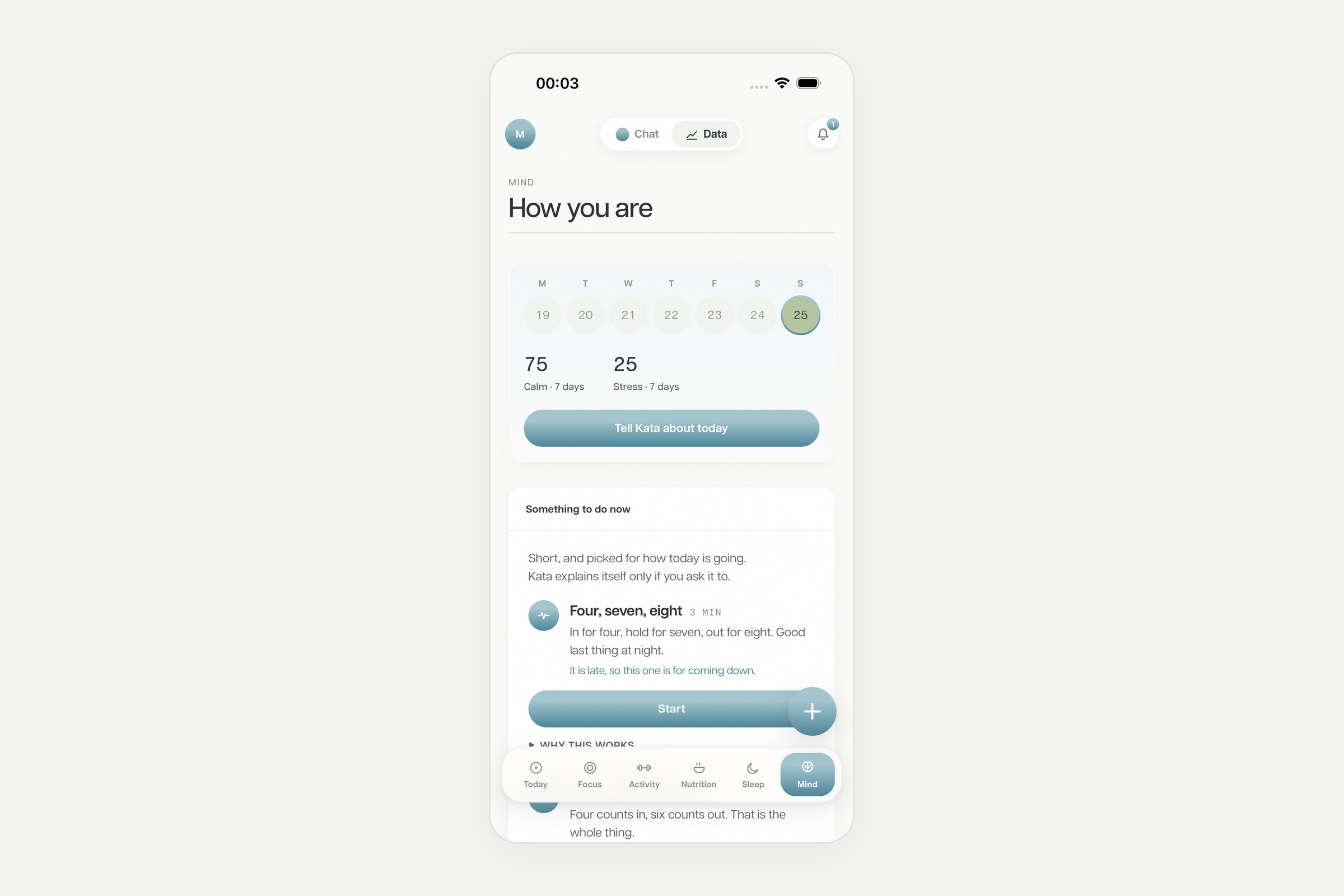
Short, and picked for today
Something to do now offers a few practices, chosen for how your day is going and the time it is. Each one is short enough that you will actually do it:
- A longer breath out. Four counts in, six counts out.
- Box breathing. Four in, four hold, four out, four hold, for when your attention is pulled in five directions.
- Four, seven, eight. In for four, hold for seven, out for eight, a good last thing at night.
- Five minutes of daylight. Outside, eyes up, no phone.
- A ten minute walk. Out the door and back, nothing in your ears.
- Five things you can see. Naming what is actually in the room, when your head is running ahead.
- Unclench. Jaw, shoulders, hands. One minute.
- The one thing. Write down the single next task, close everything else.
When Kata puts one in front of you, it says why in one line, and only from something real: you said today feels heavy, last night was short, it is late and the point is to come down. It never tells you that you are stressed when you have not said so.
Behind each practice is a small "Why this works", written modestly. We were strict about that part. Kata's words for the longer breath out say it is a way to feel steadier now, not a treatment for anything. That is also what the research supports. In a 2023 study with 108 adults who practised for five minutes a day for a month, every group reported less anxiety and a better mood, and breathing with a long, slow exhale lifted positive mood more than mindfulness meditation did. The authors called it exploratory, and the groups were small. A few minutes of slower breathing is not a cure. It is a reliable way to change the next ten minutes.
Telling Kata how you are
When you want to, you can tell Kata about your day in four short questions: could you hold your attention, how much was in the tank, was anything making today heavier, did today feel settled. Answer what fits and skip what does not. Anything you leave blank stays blank.
There is also a place for your own words. Those stay on your phone. Kata reads the four answers so it knows how you are, and never the note you wrote.
Stress, read twice
If you connect a wearable, Mind keeps two readings apart on purpose: what you said, and what your body measured, from recovery, heart rate variability or resting heart rate against your own usual. Often they agree. When they do not, when you feel fine but your body reads loaded, or the other way round, that is usually the part worth looking at. Both are true, and Kata shows both rather than blending them into one number.
Patterns, without claims
Over weeks, Mind starts to notice things that happen together: calm days that cluster after early nights, focus that reads higher after seven hours of sleep, more mental energy on the days you train. Kata waits until there are enough answered days before it says anything, and when nothing stands out, it says that too. It notices what happens together. It never claims one thing caused another.
When it is more than a loud day
Mind is for ordinary days, the busy ones and the heavy ones. It is not a therapist and it does not diagnose. If things have felt heavy for weeks, or you are thinking about harming yourself, please talk to your doctor or someone you trust. In Switzerland, Die Dargebotene Hand answers on 143, day and night.
Why we built it this way
When we think about what actually helps on a hard day, it is almost never more information. It is a small, doable step, and the feeling that someone noticed. Mind tries to be both: one short thing to do, and a quiet record of how you have been, kept with you.